
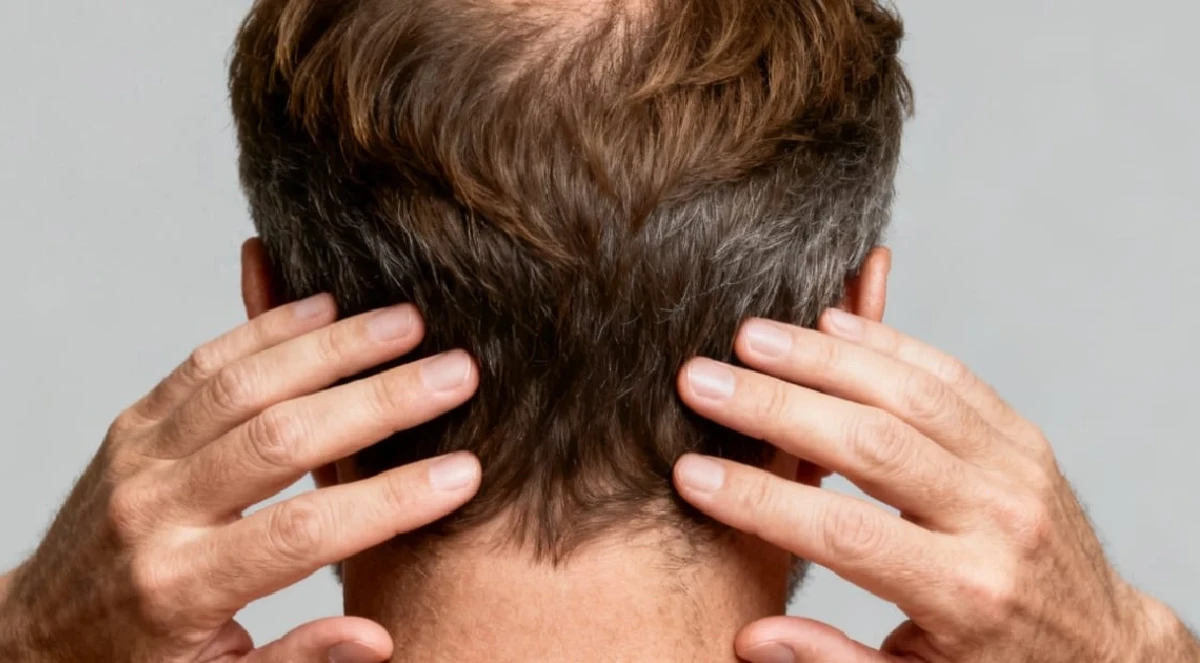
How to Read Your Own Hair Loss Progression
Clinical content from Jeffrey Vogel, MD, MPH – Chief Medical Officer, Boundless
Most men have a vague sense of where they stand. Translating that into a clear picture of what stage you are at, what is likely to happen next, and what your options are gives you meaningfully more leverage than "I think I'm thinning."
Here is how to assess your own progression.
Step 1: Use the Norwood scale as a reference
The Norwood-Hamilton scale is the standard clinical tool for classifying male pattern hair loss. Seven stages, from no significant loss (I) to the most advanced horseshoe pattern (VII).
Norwood I–II: minimal or early temporal recession. Most men at this stage do not consider themselves to have hair loss yet, though miniaturization is often already underway. This is the highest-optionality zone.
Norwood III–III Vertex: the first stage typically described as visible "balding." Deep temporal recession, with early vertex involvement in the Vertex variant. Strong candidate for Core protocols. This is when most men first seek treatment – which is reasonable, though earlier is better.
Norwood IV–V: more pronounced vertex loss, with the two zones beginning to connect. Core protocols are still appropriate and can produce meaningful results. Advanced protocols may be indicated depending on pace of progression.
Norwood VI–VII: zones fully merged, with only the lateral and occipital band remaining. Focus shifts toward stabilizing remaining hair and surgical candidacy discussions. [See this post for the non-invasive vs transplant decision framework.]
Step 2: Examine the right indicators
Standard mirror observation under normal lighting is unreliable for early-stage loss. Better indicators:
Compare against photographs from five years ago – particularly from above or from the crown in direct overhead lighting. The difference is often more apparent in comparison than in daily observation.
Look at strand quality, not just count. Hair in actively miniaturizing zones often feels lighter and softer than hair in stable zones. Running your fingers through different areas of the scalp can reveal this before density loss is visually obvious.
Look for variation in hair shaft diameter within the same area – some strands noticeably finer than others. This is the hallmark finding of androgenetic alopecia in the early stage.
Step 3: Translate stage to options
Early stages (Norwood I–II): the most optionality. Most follicles are active. Non-invasive protocols are highly effective. Prescription support started now compounds for years.
Mid stages (Norwood III–IV): active intervention produces strong results because viable follicle populations are still substantial.
Advanced stages (Norwood V–VII): fewer active follicles in the most affected zones. Non-invasive protocols still support remaining native hair. Surgical evaluation becomes more relevant.
Step 4: Track with photographs, not memory
Memory is unreliable for gradual change. Monthly photographs with consistent lighting, angle, and a slightly damp, combed-back scalp create a comparison baseline that makes progress visible. [See this post for more info on tracking progression.]
Final Thoughts
Most men know something is happening with their hair before they act on it. The gap between noticing and acting is typically where the most viable follicles are lost.
To build a strategy matched to your specific stage, explore our Hair page HERE. Or, start with a consult HERE.