
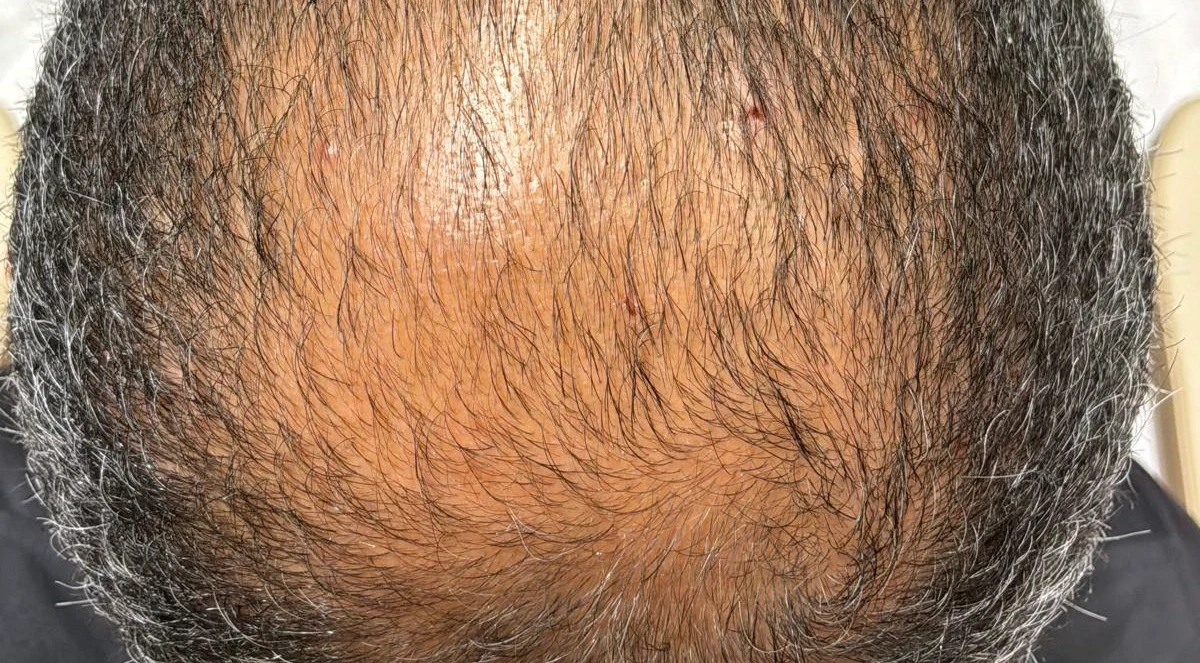
What Is Miniaturization – and Why Catching It Early Changes Your Options
Clinical content from Jeffrey Vogel, MD, MPH – Chief Medical Officer, Boundless
"The men who get the best outcomes from hair restoration are almost always the ones who came in earlier than they thought they needed to. Miniaturization can be well underway before it is visible in a mirror. By the time it is obvious, a meaningful portion of the viable treatment window has already passed."
What miniaturization is and why it happens
Healthy hair follicles cycle through a predictable pattern: anagen (active growth, 2–6 years), catagen (transition, 2–3 weeks), and telogen (resting, 1–4 months). In men with genetic sensitivity to DHT, the follicles in susceptible areas respond to DHT by progressively shortening the anagen phase and shrinking in size with each successive cycle.
Each successive cycle produces a hair that is shorter, thinner, and less pigmented than the last. Eventually, the follicle produces only vellus hair – the fine, nearly invisible hair that provides minimal coverage. The follicle count stays constant throughout this process; the follicles do not disappear, they transform (Natarelli et al., Journal of Clinical Medicine, 2023; Altendorf et al., Physiological Reviews, 2025).
This distinction matters clinically: a miniaturized follicle is still alive and potentially reversible. A dormant follicle that has reached the end stage without intervention is a different situation.
Why it is so hard to see early
The visual threshold where hair loss becomes clearly apparent to casual observation is often around 50% reduction in hair density. That means the miniaturization process can be substantially advanced – active across dozens or hundreds of follicles – before it is consistently noticeable in the mirror.
Hair diameter variability, where some strands in an area are visibly finer than others, is the hallmark early finding of androgenetic alopecia (present in approximately 94% of AGA patients on trichoscopy). This is often the first observable sign – and it is easy to dismiss.
Why early action changes outcomes
A miniaturizing follicle can respond to regenerative protocols. A dormant one cannot. The treatment window for any given follicle is not indefinite – the longer it has been in the miniaturized state without intervention, the harder it becomes to fully reverse.
The men who see the most dramatic results from non-invasive hair restoration are consistently the ones who started earlier than they thought they needed to. [See this post on how to assess your own progression stage.]
Final Thoughts
Miniaturization is not the end of the story. It is a process that can be slowed, stabilized, and often partially reversed – but the window to do that most effectively is earlier than most men act.
To learn more, explore our Hair page HERE. Or, start with a consult HERE.